
Feeling confident about the words of an exam question can support stronger responses for many students at GCSE or A-level. Understanding commonly used command words and what each is asking students to do is key to improved exam performance.
- What are command words?
- Examples of command words and their meanings
- Why are command words important?
- Teaching resources to support with command words
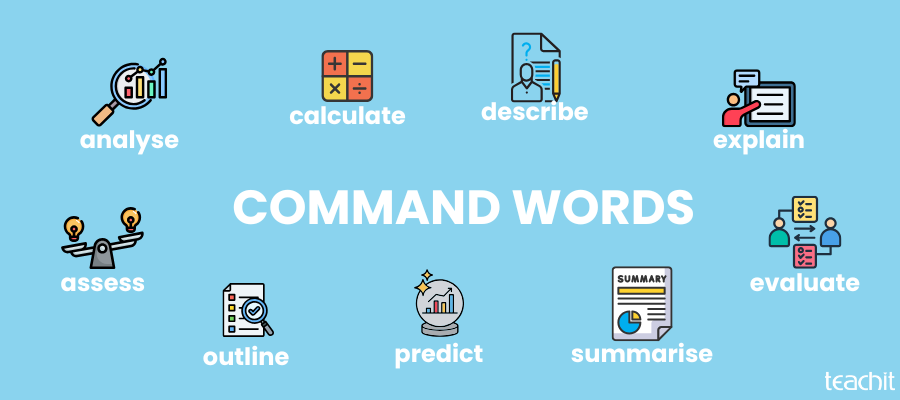
What are command words?
Command words are used in exam questions or descriptions to tell a student how to answer to gain the full marks available.
These command words also appear in assessment questions or tasks and are likely familiar from both primary and secondary school. A key example is ‘describe’, where a student is asked to create a detailed account of something, explaining main points or major characteristics.
Examples of command words and their meanings
Knowing what important command words mean and what they are asking a student to do in their response is essential to unlocking a question and giving a complete answer.
Here are some common command words, along with their meanings.
|
|
Analyse |
Break a topic or issue down into parts to show their relationship to each other and examine the topic in detail. | ||
 |
Assess |
Recognise and weigh up each side of a topic or argument to prove validity or effectiveness. | ||
 |
Calculate |
Work out an answer related to, or the value of, facts, figures or information. | ||
 |
Compare |
Identify the similarities and differences between two or more things. | ||
 |
Consider |
Review and examine given information. | ||
 |
Contrast |
Identify and comment on differences between two or more things. | ||
 |
Define |
Give the exact meaning of a word, concept, process or idea. | ||
 |
Describe |
Give a detailed account of something, outlining its parts or features. | ||
 |
Develop |
Build on given information or take something to the next stage. | ||
 |
Discuss |
Present arguments, viewpoints or perspectives on an idea or topic. | ||
 |
Draw |
Draw could mean to illustrate a concept or idea in a drawing or diagram. It could also signal drawing a conclusion or summing up the main points of an idea or line of argument. | ||
 |
Evaluate |
Consider the elements of a topic or key ideas in a line of argument and make a judgement based on your considerations. | ||
 |
Explain |
Identify and define the causes, reasons or features of an event, idea or concept to show how something happened, occurred or how a result was formed. | ||
 |
Identify |
Name the constituent parts of an idea, concept or event. Provide an answer from a range of possibilities. | ||
 |
Justify |
Use supporting evidence to confirm a conclusion to a line of argument or exploration of an idea. | ||
 |
Label |
Name the parts or elements of an object, idea or event. | ||
 |
Name |
Use a word to define an idea, concept or process. | ||
 |
Outline |
Give a summary of a concept, idea or event. | ||
 |
Predict |
Suggest what could happen based on existing information. | ||
 |
|
Show |
Explain how something happened or reveal information. | |
 |
State |
Make a statement or give a response demonstrating a fact, opinion or perspective. | ||
 |
Suggest |
Apply understanding to an idea or event or provide recommendations where there are a variety of reasonable responses. | ||
 |
Summarise |
Give the main points of an idea, concept, event or process. |


Why are command words important?
Command words are important in helping students in exams or assessments understand what they are being asked to do and can complete the task to the best of their ability to gain relevant marks.
Here are four reasons why students should have a good grasp of command words:
1. Clear communication
When a student understands the purpose of the command word and how to answer the question or task, they can communicate their response in a way that fulfils the question criteria.
2. Structured answers
Composing effective answers is key to success in exam or assessment conditions. There is a difference between how students may organise a response to a ‘compare’ question and how they would structure a ‘describe’ answer. Knowing exactly what the command word is asking them to do helps complete an effective answer.
3. Higher marks
It’s very difficult for students to gain full marks if they don’t understand what the question requires them to do in response. In contrast, when students know what the command word means, they can construct an answer that meets the criteria to gain as many marks as possible.
4. Improved understanding
Appreciating the context of each command word enables students to increase their understanding of exam-style questions and responses, what is expected of them with each command word, and how to meet exam requirements. When students have this level of understanding, they will gain more confidence about their overall exam performance.
Teaching resources to support with command words
Help your students develop confidence and master command words with these carefully selected subject-specific resources!
English
- Essay planning - accessible guide for A-level students.
- GCSE English Literature essay planning grid - differentiated prompts for two essay planning activities.
- Exam style question on charity in *A Christmas Carol -* explains tricky exam-related vocabulary.
- Essay planning and preparation: *Animal Farm -* explores command words and essay structure.
Science
- Command words - GCSE revision - examines exam command words and differences between them.
- Describe and explain - enzyme graphs - helps KS4 students understand the subtleties between ‘describe’ and ‘explain’.
- Respiratory system and breathing - explores 4 different common exam command words.
- Photosynthesis revision board - summarises process with important command word explanation.
- Understanding prokaryotes and eukaryotes - explores topic and use of command words in exam questions.
- Cell assessment frame - explores the use of low-level to high-level command words.
Geography
- Command words: GCSE revision - how to achieve high marks in geography through command word understanding.
- Understanding exam command words - explains the differences between command words found in geography exam questions.
- Developing extended answers - supports students to write full responses to exam questions with an exploration of key command words.
- Geography exam question review template - guide to systematic exam responses and exploration of command prompts.
- Deconstructing an exam question - examines key aspects of exam questions, including important command words.
History
- Command words in history - introduces key command words to year 7 students.
- Hexagon focus: question planning and revision - ideal for deconstructing exam-style questions and for planning responses.

