
The busy life of a teacher can lead to overwhelm for some. The demands of managing classrooms, marking, and data analysis can feel constant, with teachers juggling to get tasks done.
In this article, we explore an effective tool: the Circle of Control technique. We explain what the Circle of Control is and how you can optimise it to improve workflow quality and better respond to challenges.
Want a practical tool? Download our free circle of control template. It helps you navigate uncertainty and transitions while maintaining focus on key priorities.
Contents
- What is the 'Circles of influence and control' technique?
- Why use the circle of control technique?
- What is the circle of influence?
- What is the circle of control?
- How can teachers use the circle of control theory?
- More support for managing change
What is the 'Circles of influence and control' technique?
This framework helps you identify what you can and cannot control, allowing you to focus your energy where it matters most.
- Based on Stephen Covey's theory, which encourages us to focus on what we can control and influence
- Helps you deal practically with change and focus on areas where you can make a difference
- Provides clarity about aspects of work and life you can control
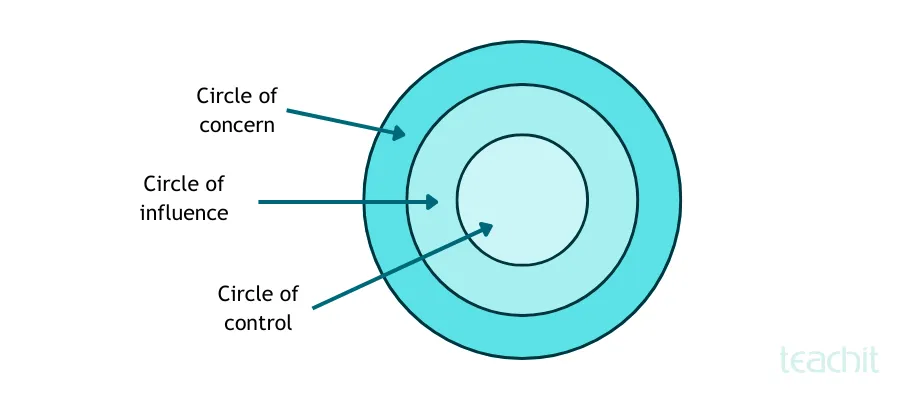
The three circles include:
- Circle of concern: Things we can't control (weather, world events, other people's actions)
- Circle of influence: Things we can partially affect (some decision making at work)
- Circle of control: Things we have power over (our actions, behaviours, emotions)
For example, you might be asked to teach a new class that's not on your timetable. Using the Circles of control technique, you'll be able to manage any feelings of anxiety or frustration you feel and work through them to a better place with a clear action plan.
Not only will this give you more clarity about the aspects of work and life you can control, but you'll also gain insight into what is outside your sphere of influence. Next time an event or emotion causes you worry, you can apply the Circles of control solution to create a positive action plan and leave that worry behind.
Why use the circle of control technique?
This technique is especially valuable for managing stress during situations outside your control.
This is important for teachers and people working in education, as change happens all the time. The academic year is constantly on the move, with new priorities, targets and strategies being introduced at different points in the calendar.
Common challenges teachers face:
- Behavioural issues and diverse learning needs
- Time management and compressed timetabling
- Uneven work-life balance
- Plentiful paperwork and administrative tasks
- Data analysis
- Curriculum changes
- Parental and senior leadership expectations
- Reduced resources
In any of these circumstances, you may experience feelings of overwhelm and consider events to be out of your control. This could lead to some negative thought patterns and undue levels of stress.
Practical example: Managing a challenging class
For example, you teach a lively year 10 class. You're struggling to get behaviour to the appropriate standard and feel like everything you try isn't having the desired effect. You're not currently able to control the attitudes of others, and this is making you feel frustrated and anxious.
The Circle of Control technique could generate some practical solutions and offer you relief in this situation.
Steps to apply the technique:
- Find a quiet moment to process your thoughts
- Put everything you can control (e.g., your approach to behaviour management) into the circle of control
- Put everything you can't control (e.g., students' behaviour) into the circle of concern
- Identify actions to improve the situation (e.g., adopting fresh behaviour management strategies)
Once you've completed this, you'll be able to clearly see what actions you need to take to improve the whole situation. This could include using existing strategies more effectively, such as calling parents or carers, arranging student and parent meetings or booking in detentions when necessary.
What is the circle of influence?
The circle of influence represents areas where you can exert some impact, even without direct control.
The circle of influence is the area where the things we can control and those we can't control meet. Even though you may not have direct control over a certain aspect, you might be able to use some influence to change things for the better.
Using your influence with a challenging class:
- Talk to the Head of Year, form tutors or the SEND department about challenging students
- Explore strategies that have worked with these students before
- Ask other teachers for advice if they're also struggling with the class
- Work on the consequences for poor behaviour collaboratively
These are all examples of how you can proactively influence the situation to improve student outcomes and reduce your stress levels.
What is the circle of control?
This innermost circle contains everything you have direct power over, where your decisions make an immediate impact.
The circle of control represents the parts of your life, including those at work, over which you have direct control. This is where you can make a change and have complete decision-making power. Here, you can take carefully considered action to make a positive difference.
Steps to maximise your circle of control:
- Identify aspects of a situation you can directly control
- Write down these controllable elements
- Make a list of actions to improve these aspects
- Implement these actions to increase your level of control
If we use our year 10 class example, some of the things you can control are your emotions towards the class. You may feel frustrated and resentful at their poor behaviour.
Deciding on 3 key strategies that will encourage students to behave appropriately and how you can use these practically in class will help you feel more in control and reduce your negative emotions around the situation.
How can teachers use the circle of control theory?
Teachers experience numerous transitions throughout their careers, from new roles to changing leadership.
There are likely to be multiple periods of change in a teacher's career. These could range from starting in your first job or moving into a position of responsibility. Your school might get new leadership, or you may have to take on classes you've never met before.
In any of these scenarios, you'll possibly feel that change is in control of you rather than the other way around. You haven't chosen for these things to happen, and you feel a little out of the decision-making loop.
With the circle of control theory, you can identify the things you can change, those that you can influence and those that are outside of your control. This in turn enables you to create an action plan to make improvements to your situation and reduce anxiety.
Need a practical tool to apply this technique? Download our free circle of control worksheet. This template is specifically designed to help you navigate through periods of uncertainty and professional transition, maintaining clarity and focus on your most important priorities.
More support for managing change
Beyond the Circle of Control, several other frameworks can help you navigate professional challenges.
Discovering one method to help you manage change could make you curious about other effective tools for improving your working environment and minimising stress levels.
Additional change management techniques:
- Nudge theory: Based on the idea of shifting from negative thoughts to positive feelings through small changes. Try creating a pros and cons list about a situation to see both sides.
- Kübler-Ross change curve: Maps the five stages of emotions during change (denial, anger, bargaining, depression, acceptance). Track your feelings during transitions to help regulate emotions.
- Bridges’ transition model: Helps you view change as a starting point rather than an ending, supporting more effective responses to dynamic events.
There are plenty of supportive tools and techniques to discover and explore in the Teachers' time and task management guide. It's well worth diving into for more practical advice and guidance, plus active solutions you can use today. This resource is included with Premium or is £10 to buy.

