
Teaching split digraphs can be one of the trickiest parts of phonics instruction, but it's also one of the most rewarding when pupils finally grasp the concept. This article aims to help teachers understand and teach split digraphs effectively in their classrooms.
Contents:
- What is a split digraph?
- What is an example of a split digraph?
- What are the 5 split digraphs?
- When are split digraphs taught?
- Teaching tips
- Split digraph worksheets and practice
What is a split digraph?
Before diving into split digraphs, let's quickly understand what a digraph is. A digraph is when two letters work together to make one sound, like 'sh' in 'ship' or 'ch' in 'chip'.
A split digraph occurs when a digraph is split by a consonant. It's often called a 'magic e' because the 'e' at the end of the word changes the sound of the vowel that comes before the consonant. The 'e' is silent but magical in how it affects the preceding vowel sound!
What is an example of a split digraph?
Let's look at the word 'make' as a perfect example. In this word, the 'a' and 'e' work as a team, but they're split up by the 'k'. The 'e' at the end makes the 'a' say its name (the long vowel sound) instead of the short 'a' sound we hear in 'mat'.
Here's how it works:
- 'mat' → short 'a' sound
- 'mate' → long 'a' sound (split digraph a-e)
What are the 5 split digraphs?
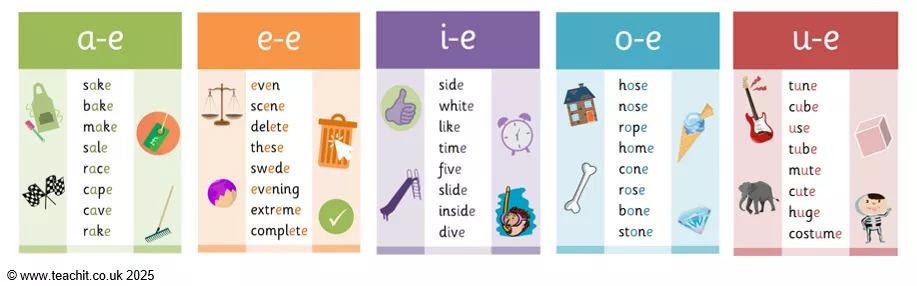
There are five main split digraphs in English:
- a-e as in 'cake', 'make', 'bake'
- e-e as in 'these', 'complete', 'delete'
- i-e as in 'time', 'slide', 'smile'
- o-e as in 'home', 'bone', 'note'
- u-e as in 'cube', 'tune', 'huge'
When are split digraphs taught?
Split digraphs are typically introduced in Year 1, usually during the spring or summer term, after children have a solid grasp of single letter sounds and basic digraphs. However, it's important to be mindful that every class is different, and some children might need more time with basic phonics before tackling split digraphs.
It's worth noting that split digraphs form part of Phase 5 of Letters and Sounds, but many modern phonics programmes might sequence them slightly differently. The key is to ensure children are confident with simple CVC words before introducing this more complex concept.
Teaching tips
Here are some practical ways to help children understand split digraphs:
- Use physical actions - get children to 'karate chop' between the split digraph to emphasise the split
- Play word sorting games - comparing words with and without split digraphs (tap/tape, cut/cute)
- Use magnetic letters or letter cards to physically manipulate the 'e' and show how it changes the word
- Create silly sentences using split digraph words to make learning fun
Remember, teaching split digraphs requires patience and lots of practice. Some children will grasp the concept quickly, while others might need more time and support. The key is to keep the learning engaging and celebrate those 'lightbulb moments' when they happen!
Split digraph worksheets and practice
Below are helpful resources for practising split digraphs. Download resources as a free PDF or subscribe to access editable and customisable versions.
- Split digraphs challenge — Perfect for phase 5 phonics, children add missing vowels and create new words, recording findings in a table.
- Split vowel cut and stick activity — Simple cut and stick activity with three worksheets covering a_e, o_e, and i_e/u_e words. Useful across reception and KS1.
- Make a split vowel star — A creative craft activity where pupils create a decorated star and movable word strip to practise reading split digraph words. Suitable for years 1-2.
- Making word cakes – blending split digraphs and graphemes — An engaging activity and worksheet for blending split digraphs and graphemes to create as many words as possible.
- Fly swatting game – split digraphs (u_e) — A fun paired activity where pupils practise reading u-e words, swat them and create sentences. Find more versions of the game for other split digraphs here.
Browse our complete collection of split digraph resources or explore our broader phonics materials.

