
The BIDMAS rule is a fundamental mathematical concept that helps students solve equations in the correct order. As maths teachers, it's essential that we help our students grasp this concept early to build their confidence in tackling more complex mathematical problems.
Contents
- What is the BIDMAS rule?
- What's the difference between BODMAS and BIDMAS?
- How to use BIDMAS
- BIDMAS examples
- Why is it important to teach BIDMAS?
- How to teach BIDMAS
- BIDMAS teaching resources
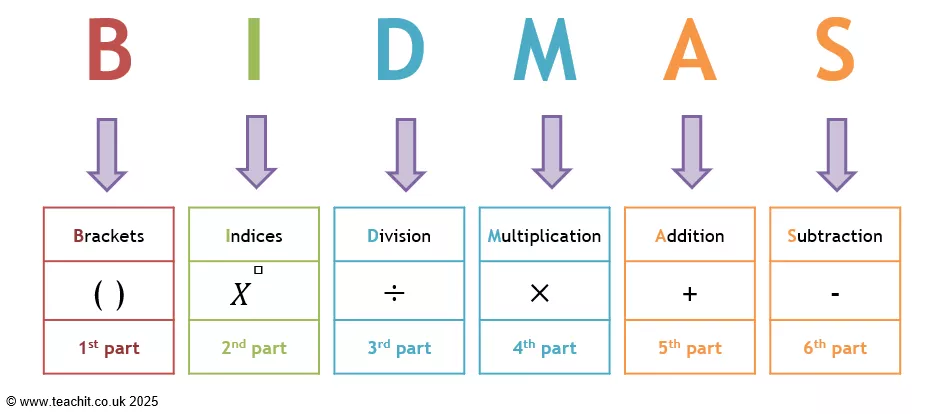
What is the BIDMAS rule?
BIDMAS (or BODMAS) is an acronym that is used to remember the correct order of operations. It stands for:
- Brackets
- Indices (powers or square roots)
- Division
- Multiplication
- Addition
- Subtraction
What's the difference between BODMAS and BIDMAS?
BODMAS and BIDMAS are essentially the same rule. The only difference is:
- BIDMAS uses 'I' for Indices
- BODMAS uses 'O' for Orders (another term for indices)
Both terms are correct, but BIDMAS is more commonly used in UK schools as 'indices' is the term students will encounter in their textbooks and exams.
How to use BIDMAS
When solving mathematical expressions, students should follow these steps:
- First, solve anything inside brackets ()
- Next, calculate any indices (powers like squared or cubed numbers)
- Then perform division and multiplication (from left to right)
- Finally, complete addition and subtraction (from left to right)
Let's look at some examples to demonstrate the BIDMAS rule, from simple to more complex problems:

BIDMAS examples
Example 1: 4 + 2 × 3
- First, check for brackets (none present)
- Check for indices (none present)
- Multiplication comes before addition
- So: 2 × 3 = 6, then 4 + 6 = 10
- Answer: 10
Example 2: (4 + 2) × 3² - 5
- First, solve brackets: (4 + 2) = 6
- Next, calculate indices: 3² = 9
- Then multiply: 6 × 9 = 54
- Finally, subtract: 54 - 5 = 49
- Answer: 49
Example 3: 2³ × (15 ÷ 3 + 2) - 4²
- First, calculate indices: 2³ = 8 and 4² = 16
- Next, solve brackets: 15 ÷ 3 = 5, then 5 + 2 = 7
- Then multiply: 8 × 7 = 56
- Finally, subtract: 56 - 16 = 40
- Answer: 40
Why is it important to teach BIDMAS?
Teaching BIDMAS is crucial because:
- It provides a clear structure for solving mathematical problems
- It ensures consistency in mathematical calculations
- It prepares students for more advanced mathematics
- It helps prevent common calculation errors
- It's essential for GCSE maths and beyond
How to teach BIDMAS
There are lots of different ways to teach BIDMAS to students. Here are our top tips:
1. Start with simple BIDMAS examples
Begin with straightforward calculations that only use two operations, then gradually increase complexity.
2. Use visual aids
Create posters or diagrams that show the order of operations. Colour-coding different operations can be particularly effective.
3. Make it memorable
Use mnemonics or stories to help students remember the order of operations. For example: "Brackets Invite Dogs, Mice And Snakes". It can be fun to encourage students to make up their mnemonics or stories.
4. Practice regularly
Incorporate BIDMAS questions into starter activities and homework assignments. Regular practice helps reinforce the concept. Quick quizzes or puzzles are an engaging way to do this.
5. Common mistakes to address
Watch out for these typical errors:
- Students performing operations from left to right without following BIDMAS
- Forgetting to complete all operations within brackets first
- Confusion between multiplication/division order and addition/subtraction order
Remember to emphasise that division and multiplication have equal priority (work left to right), as do addition and subtraction. This is often a source of confusion for students.
BIDMAS teaching resources
Use these step-by-step guides and practice activities to introduce or review the BIDMAS/BODMAS rule with students:
- An introduction to BIDMAS
- BODMAS poster
- BIDMAS / BODMAS questions worksheet
- Calculator homework sheet: BIDMAS
These quick starter quizzes and puzzles provide regular practice opportunities to strengthen students' understanding of the BIDMAS/BODMAS rule:
- Starter for 10 – BIDMAS quiz
- BIDMAS wordsearch
- Making your own sums
- BIDMAS four in a row
- BIDMAS – a crossnumber puzzle
Make BIDMAS practice fun with these challenges and games, from BIDMAS codebreakers to dice games:
- BIDMAS codebreaker
- Missing operators challenge
- Friedman numbers
- BIDMAS game: Roll the dice
- Dice investigation
Browse the full collection of BIDMAS (order of operations) resources.

